In this thesis, supervised by CENIEH researchers Alfonso Benito Calvo, Davinia Moreno García and Ana Isabel Ortega Martínez, a direct relationship is established between the formation of the cavities in the Sierra de Atapuerca and the evolution of the fluvial network in the northeast of the Duero basin
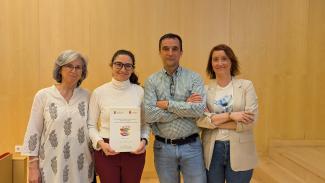
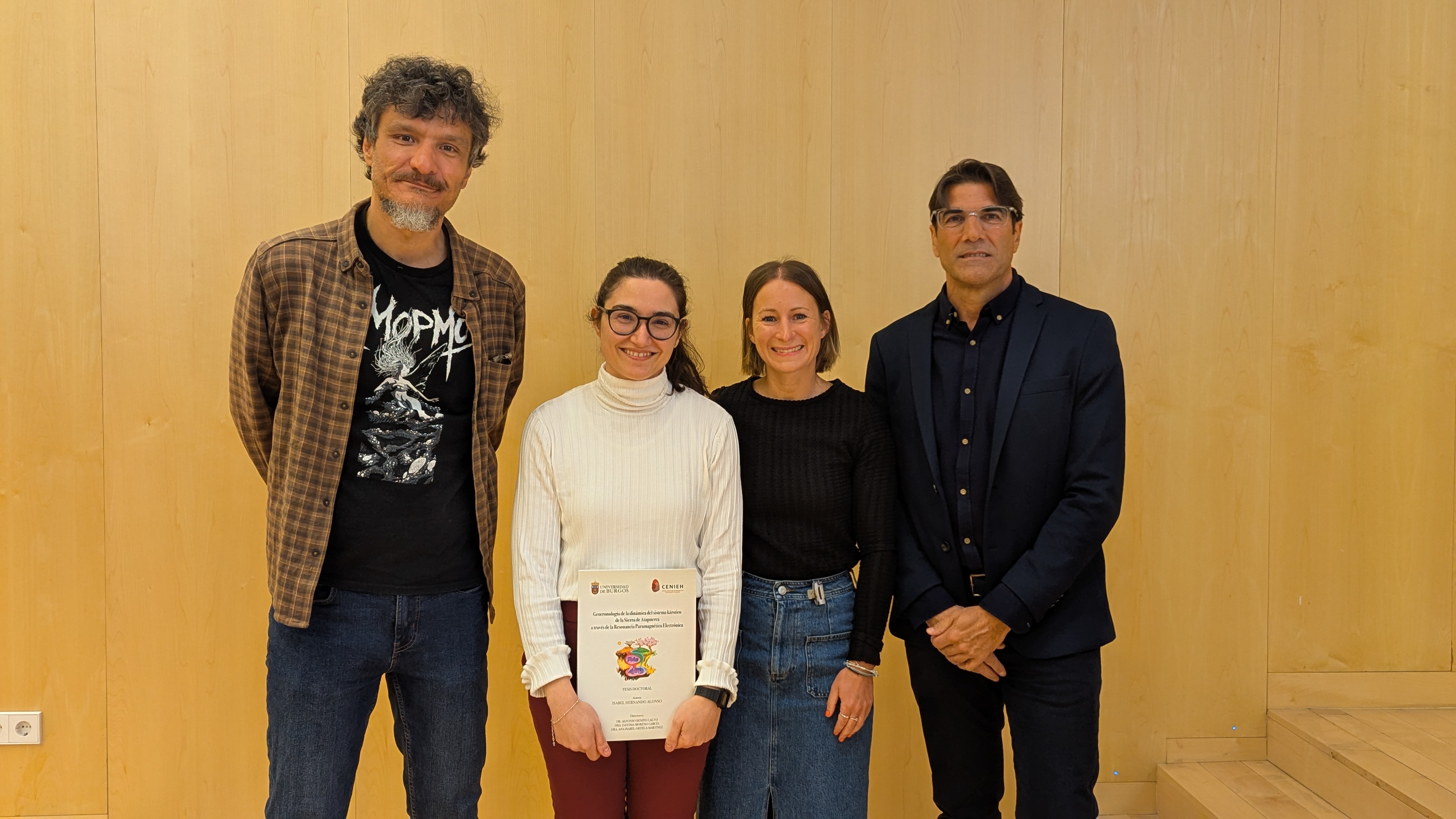
Isabel Hernando Alonso defended her doctoral thesis today, supervised by Alfonso Benito Calvo, Davinia Moreno García and Ana Isabel Ortega Martínez, researchers at the National Center for Research on Human Evolution (CENIEH), focused on the analysis of the dynamics of the karst system of the Sierra de Atapuerca and its relationship with the evolution of the Arlanzón and Arlanza rivers.
This thesis, entitled “Geochronology of the dynamics of the karst system of the Sierra de Atapuerca through Electron Paramagnetic Resonance,” has explored in depth the relationship between the formation of the cavities that host the Atapuerca archaeological sites and the evolution of the fluvial systems in the northeast of the Duero basin. To this end, Electron Paramagnetic Resonance (ESR) dating has been applied, making it possible to determine when sediments entered the caves and were deposited in nearby river valleys.
The results obtained indicate that the interaction between the fluvial network and the formation of the cavities in the Sierra de Atapuerca would have begun at least 1.7 million years ago and would have ended approximately 800,000 years ago. Furthermore, the study highlights that the rivers in this area display an immature hydrographic network compared to other valleys in the same basin, suggesting that these systems are still developing and evidencing the complex geomorphological evolution of the Duero basin.
The committee, chaired by Theodoros Karampaglidis (University of Castilla-La Mancha) and composed of José Ángel Porres Benito (University of Burgos) and Maïlys Richard (Université Bordeaux Montaigne), awarded the new PhD from the University of Burgos the highest distinction.