  • About CENIEH
    • Organization
    • HRS4R
    • Staff
    • Vacancies
    • Transparency
    • Anti-fraud plan
    • Call for Tenders
    • Quality and Preventive health policy
    • Security policy
    • Data Protection Policy
    • How to find us
  • Research
    • Lines of research
    • Archeological sites
    • Publications
    • Projects
    • Teaching
    • UCC+I
  • Infrastructure
    • Laboratories
    • Collections
    • Access and User Office
    • Consultation and rates
    • Projects
    • Library
    • Virtual tour
  • Media
    • News
    • Events
    • Press room
    • Other publications

Pie de página

  • Home
  • Directory
  • Anti-fraud channel
  • Suggestions mailbox
  • Intranet
Home
Home

Buscar

  • en
  • |
  • es

Buscar

Menu Superior

  • Home
  • Directory
  • Anti-fraud channel
  • Suggestions mailbox
  • Intranet
  • About CENIEH
  • Research
  • Infrastructure
  • Media
  • Organization
  • HRS4R
  • Staff
  • Vacancies
  • Transparency
  • Anti-fraud plan
  • Call for Tenders
  • Quality and Preventive health policy
  • Security policy
  • Data Protection Policy
  • How to find us
  • Lines of research
  • Archeological sites
  • Publications
  • Projects
  • Teaching
  • UCC+I
  • Laboratories
  • Collections
  • Access and User Office
  • Consultation and rates
  • Projects
  • Library
  • Virtual tour
  • News
  • Events
  • Press room
  • Other publications

Cannibalism of Homo antecessor was not due to food shortage

Wednesday, 03 April 2013
Cannibalism of Homo antecessor was not due to food shortage

Researchers from the Paleoecology and Paleophysiology groups at the Centro Nacional de Investigación sobre la Evolución Humana (CENIEH) has published the work "Modeling trophic resource availability for the first human settlers of Europe: The case of Atapuerca-TD6" in the Journal of Human Evolution stating that cannibalism of Homo antecessor was not due to periods of famine, as there was plenty of food resources in Atapuerca 800,000 years ago.
Latest news

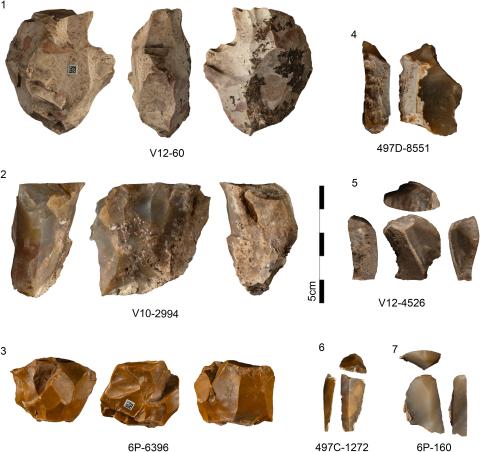
Representative lithic materials from the TD10.2-BB assemblage/Arteaga-Brieba et al
The Gran Dolina site at Atapuerca reveals an almost exclusive use of local chert 400,000 years ago
Gerze coast, eastern Sinop Peninsula, key area of the study/ Erturaç et al.estudio/Erturaç et al
Black Sea highstands during the last glacial period reconstructed
Fracture types based on their morphology identified in the study/ Daniel Rodríguez Iglesias
A biomechanical study provides new insights into the interpretation of cranial fractures in the fossil record
The landscape of Nihewan Basin/Shi-Xia Yang et al
A new study places China at the center of the debate on human evolution
Noticia publicada en la Voz del Patio
The CENIEH launches a pioneering project with Burgos Prison
  • About CENIEH
    • Organization
    • HRS4R
    • Staff
    • Vacancies
    • Transparency
    • Anti-fraud plan
    • Call for Tenders
    • Quality and Preventive health policy
    • Security policy
    • Data Protection Policy
    • How to find us
  • Research
    • Lines of research
    • Archeological sites
    • Publications
    • Projects
    • Teaching
    • UCC+I
  • Infrastructure
    • Laboratories
    • Collections
    • Access and User Office
    • Consultation and rates
    • Projects
    • Library
    • Virtual tour
  • Media
    • News
    • Events
    • Press room
    • Other publications
Ministerio de Ciencia e Innovación Junta de Castilla y León

Contact

Centro Nacional de Investigación sobre la Evolución Humana, CENIEH

Paseo Sierra de Atapuerca, 3

09002 Burgos, España

Tel: +34 947040800

Fax: +34 947040810

contacto@cenieh.es

Legal warning
Cookies policy