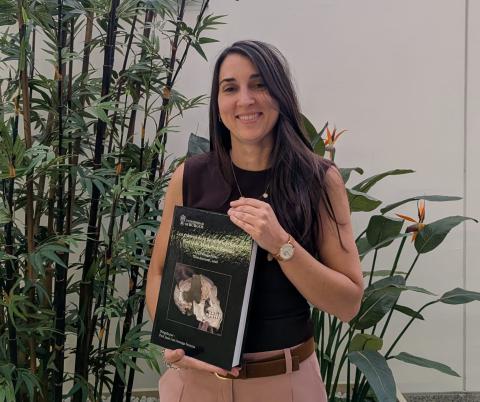
In this thesis, supervised by Juan Luis Arsuaga, Scientific Director of the MEH, nearly 2,000 fossil fragments are analyzed, enabling a precise reconstruction of a key population for understanding the origin of Neanderthals
Researcher Ana Pantoja Pérez has defended today her PhD thesis at the Centro Nacional de Investigación sobre la Evolución Humana (CENIEH), entitled “The crania from Sima de los Huesos (Sierra de Atapuerca, Burgos)”. The thesis was supervised by Juan Luis Arsuaga Ferreras, Director of the Museo de la Evolución Humana (MEH) and co-director of the Atapuerca sites.
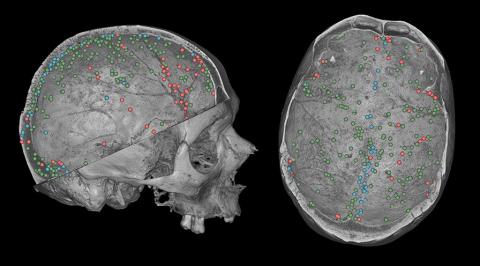
The research focuses on the analysis of nearly 2,000 cranial fragments belonging to at least 21 individuals, providing a highly reliable reconstruction of this Middle Pleistocene population. The results reveal a level of variability comparable to that of modern humans, as well as a balanced sex ratio among adult individuals.
From an evolutionary perspective, the crania exhibit an intermediate morphology between Homo erectus, Neanderthals and Homo sapiens, suggesting that this population may be close to the common ancestor of these lineages. In addition, several facial and cranial traits already point toward the Neanderthal pattern, although they are not yet fully developed.
Overall, the study highlights the significance of Sima de los Huesos as a key site for understanding the evolutionary processes that led to the emergence of Neanderthals in Europe.
The doctoral examination committee, chaired by Juan Francisco Pastor Vázquez (Universidad de Valladolid) and comprising Yoel Rak (Tel Aviv University) and Almudena Estalrrich Albo (Museo Nacional de Ciencias Naturales), awarded Ana Pantoja Pérez the highest distinction, “sobresaliente cum laudem”.