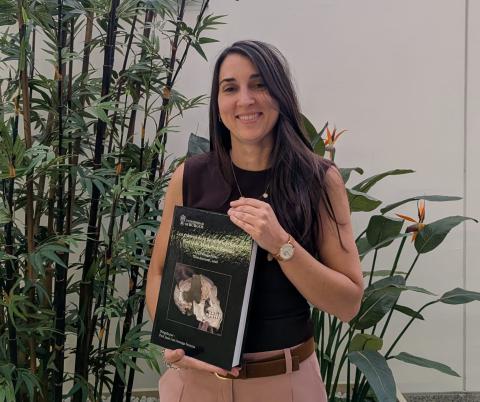
CENIEH is part of the international team publishing in Nature Ecology & Evolution a comprehensive review of two million years of fossil and archaeological evidence from China, highlighting the dynamic role of East Asia in the evolution of the genus Homo


The Centro Nacional de Investigación sobre la Evolución Humana (CENIEH) is participating in an international study led by the Institute of Vertebrate Paleontology and Paleoanthropology (IVPP) in Beijing, with the involvement of Griffith University (Australia), which an integrated review of China’s fossil, archaeological, and genomic record spanning the last two million years. The study concludes that East Asia, far from being a peripheral setting in human evolutionary history, may have functioned as a dynamic epicenter of Homo lineages, harboring greater biological and cultural diversity than previously recognized.
Published today in Nature Ecology & Evolution, the paper, authored by Shi-Xia Yang (IVPP, Chinese Academy of Sciences), María Martinón-Torres (CENIEH), and Michael Petraglia (Griffith University), analyzes and integrates the major paleoanthropological and archaeological discoveries made in China over recent decades and explores their evolutionary implications. According to the authors, evolutionary dynamics outside Africa were more complex and geographically widespread than suggested by earlier simplified models.
The study is based on a comprehensive review of the Chinese fossil and archaeological record published over recent decades, combined with the authors’ direct experience analyzing original materials from various Asian sites. The integration of first-hand research and critical synthesis offers an updated and nuanced perspective on China’s role in the evolution of the genus Homo.
Transitional hominins
One of the central themes of the study is the reassessment of the so-called “transitional” hominins of the Chinese Middle Pleistocene, which have traditionally been difficult to classify. Fossils such as Harbin, Dali, Jinniushan, Xujiayao, and Hualongdong display unique combinations of primitive and derived traits that do not fit neatly within Homo erectus, Homo neanderthalensis or Homo sapiens. These may include the elusive Denisovans, although the possibility remains that they represent other previously unknown lineages potentially related to the origins of modern humans.
In recent years, new species such as Homo longi and Homo juluensis have been proposed. These may include the elusive Denisovans, although the possibility remains that they represent other previously unknown lineages potentially related to the origins of modern humans. In addition, fossils such as Yunxian 2, from the Early Pleistocene, may point to deeper divergences between the Sapiens and Neanderthal lineages. This hypothesis resonates with earlier proposals derived from findings in the World Heritage sites of Sierra de Atapuerca in Burgos (Spain).
“The discovery of Homo antecessor suggested the existence of a basal population, close to one million years old, involved in the divergence of modern humans and Neanderthals. While research on our origins has traditionally focused on Africa, the fossil record of Europe and China is essential for understanding the evolutionary history of Homo sapiens”, explains María Martinón-Torres, director of CENIEH and co-director of the Atapuerca excavations.
The study also revisits the chronology of the arrival of Homo sapiens in China. Evidence from southern sites suggests a presence earlier than the conventionally accepted 50,000 years, in some cases exceeding 100,000 years. The morphological variability observed in these fossils may reflect multiple waves of dispersal and episodes of interaction and hybridization among populations.
Bones, stones and molecules
Hominins are found from high latitudes to high altitudes, evincing their extraordinary adaptive capacity. As Shi-Xia Yang, archaeologist at IVPP and lead author of the study, explains: “The Chinese archaeological record shows that human history in Asia was dynamic, innovative, and deeply adaptive. During the Middle Pleistocene and the onset of the Late Pleistocene, we document remarkable innovations, such as bone and wooden tools, possible engravings, ochre processing, and the occupation of extreme environments.”
According to Michael Petraglia, Director of the Australian Research Center for Human Evolution of Griffith University “this behavioral flexibility would have been key to the expansion and persistence of different human populations under changing climatic conditions. These innovations clearly coincide with an expansion in brain size.
The fossil record of Europe and China is essential for understanding the evolutionary history of Homo sapiens
The team emphasizes the need for closer integration of anatomical, molecular, and archaeological data to advance the reconstruction of human evolution in East Asia. “Paleoproteomics is emerging as a fundamental tool for deciphering our origins,” the authors conclude, “but it must be accompanied by detailed study of fossil morphology. Without genuine dialogue between disciplines, interpretations will inevitably remain incomplete.”
International consortium
The authors are members of the recently established ARC Centre of Excellence for Transforming Human Origins Research, an international consortium led by Michael Petraglia and funded by the Australian Research Council with AUD 35 million over seven years. Both CENIEH and the Chinese Academy of Sciences are partners in this initiative.
This Centre aims to investigate how our species became a global species, integrating archaeological, fossil, genetic, and environmental evidence to better understand the processes that shaped human evolution and its dispersal across the planet.